
The 2018 National Book Awards Longlist: Non Fiction.
- Siddu Nirvana

- Sep 20, 2018
- 7 min read
Updated: Jul 28, 2021
The National Book Awards are a set of annual U.S. literary awards. At the final National Book Awards Ceremony every November, the National Book Foundation presents the National Book Awards and two lifetime achievement awards to authors.

One Person, No Vote: How Voter Suppression Is Destroying Our Democracy by Carol Anderson. (Bloomsbury Publishing)
In her New York Times bestseller White Rage, Carol Anderson laid bare an insidious history of policies that have systematically impeded black progress in America, from 1865 to our combustible present. With One Person, No Vote, she chronicles a related history: the rollbacks to African American participation in the vote since the 2013 Supreme Court decision that eviscerated the Voting Rights Act of 1965. Known as the Shelby ruling, this decision effectively allowed districts with a demonstrated history of racial discrimination to change voting requirements without approval from the Department of Justice.
Carol Anderson is the Charles Howard Candler Professor and Chair of African American Studies at Emory University. She is the author of White Rage, which won the National Book Critics Circle Award, Bourgeois Radicals, and Eyes off the Prize. She was named a Guggenheim Fellow for Constitutional Studies. She lives in Atlanta, Georgia.
Get yourself a copy:

The Indian World of George Washington: The First President, the First Americans, and the Birth of the Nation by Colin G. Calloway. (Oxford University Press)
The Indian World of George Washington offers a fresh portrait of the most revered American and the Native Americans whose story has been only partially told. Calloway's biography invites us to look again at the story of America's beginnings and see the country in a whole new light.
Colin G. Calloway is the John Kimball Jr. 1943 Professor of History and Native American Studies at Dartmouth College. His previous books include A Scratch of the Pen and The Victory with No Name. He has been the recipient of numerous awards, including the Merle Curti Award and the American Indian History Lifetime Achievement Award.
Get yourself a copy:
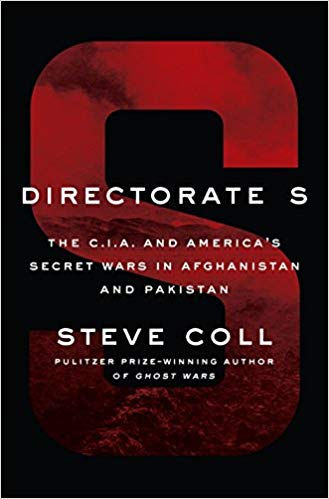
Directorate S: The C.I.A. and America’s Secret Wars in Afghanistan and Pakistan by Steve Coll. (Penguin Press / Penguin Random House)
Resuming the narrative of his Pulitzer Prize-winning Ghost Wars, bestselling author Steve Coll tells for the first time the epic and enthralling story of America's intelligence, military, and diplomatic efforts to defeat Al Qaeda and the Taliban in Afghanistan and Pakistan since 9/11.
Steve Coll is the author of the Pulitzer Prize-winning Ghost Wars and the dean of the Graduate School of Journalism at Columbia University, and from 2007 to 2013 was president of the New America Foundation, a public policy institute in Washington, D.C. He is a staff writer for The New Yorker, and previously worked for twenty years at The Washington Post, where he received a Pulitzer Prize for explanatory journalism in 1990. He is the author of seven books, including On the Grand Trunk Road, The Bin Ladens, Private Empire, and Directorate S.
Get yourself a copy:

Brothers of the Gun: A Memoir of the Syrian War by Marwan Hisham and Molly Crabapple. (One World / Penguin Random House)
A bracingly immediate memoir by a young man coming of age during the Syrian war, Brothers of the Gun is an intimate lens on the century's bloodiest conflict and a profound meditation on kinship, home, and freedom.
Molly Crabapple, an artist and writer in New York, has drawn in Guantanamo Bay, in Abu Dhabi’s migrant labor camps, and with rebels in Syria, and received widespread praise for her illustrated memoir Drawing Blood. Crabapple is a contributing editor for Vice and has written for The New York Times, The Paris Review, and Vanity Fair. Her work is in the permanent collection of the Museum of Modern Art.
Marwan Hisham is a Syrian freelance journalist who, since 2014, has covered Syria, Iraq, and Turkey. His work has been published in Vanity Fair, The New York Times, The Intercept, and Foreign Policy.
Get yourself a copy:

American Eden: David Hosack, Botany, and Medicine in the Garden of the Early Republic by Victoria Johnson. (Liveright / W. W. Norton & Company)
On a clear morning in July 1804, Alexander Hamilton stepped onto a boat at the edge of the Hudson River. He was bound for a New Jersey dueling ground to settle his bitter dispute with Aaron Burr. Hamilton took just two men with him: his “second” for the duel, and Dr. David Hosack.
As historian Victoria Johnson reveals in her groundbreaking biography, Hosack was one of the few points the duelists did agree on. Summoned that morning because of his role as the beloved Hamilton family doctor, he was also a close friend of Burr. A brilliant surgeon and a world-class botanist, Hosack—who until now has been lost in the fog of history—was a pioneering thinker who shaped a young nation.
Victoria Johnson, a former Cullman Fellow, is currently an associate professor of urban policy and planning at Hunter College in New York City, where she teaches on the history of New York City.
Get yourself a copy:

The Tangled Tree: A Radical New History of Life by David Quammen. (Simon & Schuster)
In The Tangled Tree, David Quammen, “one of that rare breed of science journalists who blends exploration with a talent for synthesis and storytelling” (Nature), chronicles these discoveries through the lives of the researchers who made them—such as Carl Woese, the most important little-known biologist of the twentieth century; Lynn Margulis, the notorious maverick whose wild ideas about “mosaic” creatures proved to be true; and Tsutomu Wantanabe, who discovered that the scourge of antibiotic-resistant bacteria is a direct result of horizontal gene transfer, bringing the deep study of genome histories to bear on a global crisis in public health.
David Quammen’s fifteen books include The Tangled Tree, The Song of the Dodo, The Reluctant Mr. Darwin, and Spillover, a finalist for the National Book Critics Circle award. He has written for Harper’s, The Atlantic, Rolling Stone, The New York Times Book Review, Outside, and Powder, among other magazines, and is a contributing writer for National Geographic. He wrote the entire text of the May 2016 issue of National Geographic on the Greater Yellowstone ecosystem—the first time in the history of the magazine that an issue was single-authored. Quammen shares a home in Bozeman, Montana, with his wife, Betsy Gaines Quammen, an environmental historian, and with two Russian wolfhounds and a cross-eyed cat.
Get yourself a copy:

Heartland: A Memoir of Working Hard and Being Broke in the Richest Country on Earth by Sarah Smarsh. (Scribner / Simon & Schuster)
During Sarah Smarsh’s turbulent childhood in Kansas in the 1980s and 1990s, the forces of cyclical poverty and the country’s changing economic policies solidified her family’s place among the working poor. By telling the story of her life and the lives of the people she loves, Smarsh challenges us to look more closely at the class divide in our country and examine the myths about people thought to be less because they earn less. Her personal history affirms the corrosive impact intergenerational poverty can have on individuals, families, and communities, and she explores this idea as lived experience, metaphor, and level of consciousness.
Sarah Smarsh has covered socioeconomic class, politics, and public policy for The Guardian, VQR, NewYorker.com, Harpers.org, The Texas Observer, and many others. She is currently a Joan Shorenstein Fellow at Harvard University's Kennedy School of Government. A former professor of nonfiction writing, Smarsh is a frequent speaker on economic inequality and related media narratives. She lives in Kansas. Heartland is her first book.
Get yourself a copy:

Call Them by Their True Names: American Crises (and Essays) by Rebecca Solnit. (Haymarket Books)
In this powerful and wide-ranging collection of essays, Solnit turns her attention to the war at home. This is a war, she says, “with so many casualties that we should call it by its true name, this war with so many dead by police, by violent ex-husbands and partners and lovers, by people pursuing power and profit at the point of a gun or just shooting first and figuring out who they hit later.” To get to the root of these American crises, she contends that “to acknowledge this state of war is to admit the need for peace,” countering the despair of our age with a dose of solidarity, creativity, and hope.
Rebecca Solnit is a writer, historian, and activist, and the author of over eighteen books on feminism, western and indigenous history, popular power, social change and insurrection, wandering and walking, hope and disaster, including the books Men Explain Things to Me and Hope in the Dark, both with Haymarket Books; a trilogy of atlases of American cities; The Faraway Nearby; A Paradise Built in Hell: The Extraordinary Communities that Arise in Disaster; A Field Guide to Getting Lost; Wanderlust: A History of Walking; and River of Shadows: Eadweard Muybridge and the Technological Wild West, for which she received a Guggenheim, the National Book Critics Circle Award in criticism, and the Lannan Literary Award. A product of the California public education system from kindergarten to graduate school, she is a regular contributor to The Guardian.
Get yourself a copy:

The New Negro: The Life of Alain Locke by Jeffrey C. Stewart. (Oxford University Press)
In The New Negro: The Life of Alain Locke, Jeffrey C. Stewart offers the definitive biography of the father of the Harlem Renaissance, based on the extant primary sources of his life and on interviews with those who knew him personally. He narrates the education of Locke, including his becoming the first African American Rhodes Scholar and earning a PhD in philosophy at Harvard University, and his long career as a professor at Howard University.
Jeffrey C. Stewart is a professor of Black Studies at the University of California, Santa Barbara. He is the author of Paul Robeson: Artist and Citizen and 1001 Things Everyone Should Know About African American History.
Get yourself a copy:

We the Corporations: How American Businesses Won Their Civil Rights by Adam Winkler. (Liveright / W. W. Norton & Company)
We the Corporations chronicles the astonishing story of one of the most successful yet least well-known “civil rights movements” in American history. Hardly oppressed like women and minorities, business corporations, too, have fought since the nation’s earliest days to gain equal rights under the Constitution—and today have nearly all the same rights as ordinary people.
Adam Winkler is a professor at UCLA School of Law, where he specializes in American constitutional law. His scholarship has been cited by the Supreme Court of the United States and his writing has appeared in the New York Times, Wall Street Journal, Washington Post, Los Angeles Times, New Republic, Atlantic, Slate, and Scotusblog.
Get yourself a copy:
The judges for this non-fiction category are:


Comments